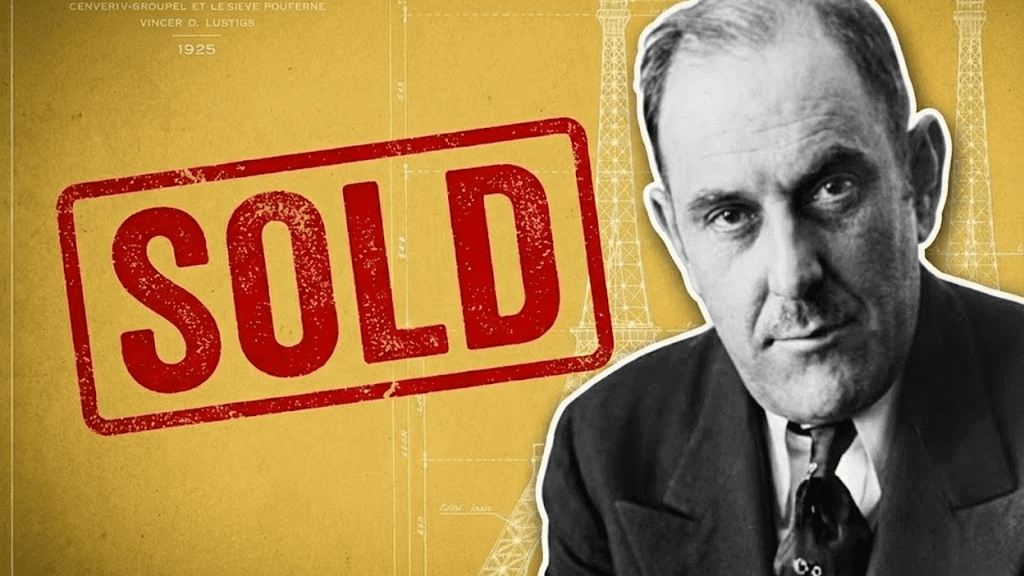
Victor Lustig sold the Eiffel Tower for scrap metal. Then, he went back to Paris a month later and tried to sell it again.
Most people laugh at this story. They think, “Wow, people in the 1920s were idiots. I’d never fall for that.”
You’re wrong.
You would fall for it.
We all would.
Lustig didn’t succeed because he was a good liar. He succeeded because he understood a fundamental glitch in the human operating system: we don’t want the truth. We want to be told that we are right, that we are special, and that our failures aren’t our fault.
That is why the question “What would Victor Lustig do today?” is terrifying.
We think we’re safe today because we have 2-Factor Authentication, blockchain ledgers, and Google.
We think technology protects us.
But Lustig didn’t hack systems; he hacked people.
And while our phones have gotten smarter, our brains are running the same buggy software.
Today, Lustig would be on your phone, in your DMs, and on your “For You” page.
Here is exactly how he did it then, and how he would destroy you now.
Selling the Eiffel Tower
One of the greatest scams almost backfired until, with some help, the victim convinced himself his money was safe. It wasn’t.
The Eiffel Tower was falling apart, and the French government was unsure whether it could foot the bill; rumors of demolition were circulating.
Victor Lustig, a veteran conman, read an article about the situation and came up with the idea of selling it.
But how could he do that?
He posed as a government official, gathered 20 local scrap metal dealers, and told them a secret:
The city, unable to afford the tower’s upkeep, was planning to sell it for scrap. However, due to the expected controversy, they wanted to finalize the details before announcing their plan.
He offered them the chance to buy the tower before anyone knew it was for sale.
With his fake documents, elegant clothing, and greed, he convinced them he was legitimate.
He secured bids from each of them and soon selected the “winner.”
The winner was André Poisson – a man with low self-esteem who believed closing this deal would elevate him in Parisian society.
But just as Lustig is about to collect the money, he senses hesitation, and the deal could collapse at any moment.
He doesn’t panic or pressure Poisson.
Instead, he changes the conversation and casually mentions that he is having financial troubles and that his government job doesn’t pay much.
And maybe a little arraignment could help secure the deal.
André felt relieved.
He wasn’t being conned.
He was being asked for a bribe.
So he gave over the cash, thrilled to have closed his deal of a lifetime.
After all, what conman asks for a bribe?
That’s the evil genius move of Lustig. He didn’t force Andre to believe him, but nudged him just enough so he could convince himself.
People are funny that way – Tell them something outright, and they’ll find 1000 reasons to doubt it. But influence them to draw their own conclusions? They’ll never question it.
Scammers, salespeople, and politicians exploit this tendency.
They don’t tell you directly how great their product or policy is.
Instead, they lead you through stories, stats, and relatable anecdotes pointing to one irresistible conclusion.
You decide that they’re the best option.
The best of them know that once you believe it, you’ll protect it as if your life depended on it.
Magicians are also masters of tapping into the power of assumptions.
They know our minds can only focus on 1 thing at a time.
So they skillfully draw our attention away from the mechanics of the trick.
They are very open and make a show of rolling up their sleeves.
They say, “Look at the sleeves; there’s nothing here.”
We conclude that he is not hiding anything because he’s being very open about it.
So our brains rush to close the case.
This is called cognitive closure – we are so eager to make sense of what we see that we fill in any gaps with what we expect to find. In other words, they show you nothing but let you see everything.
The Rumanian Money Box
If the Eiffel Tower was a symphony of audacity, the Rumanian Money Box was a masterclass in patience.
Most people imagine con men as fast-talkers—hustlers who overwhelm you with words before you can think.
Lustig knew the opposite was true. Silence is often louder than words.
He would be sitting in a high-end cruise ship lounge, quietly turning a dial on a small, beautiful cedar box. He wouldn’t approach anyone. He would just sit there, focused, waiting for curiosity to do the work for him.
Eventually, someone would ask, “What is that?”
Lustig would hush them. He’d check his watch. He’d turn a knob. Then, with the precision of a surgeon, he would extract a crisp, fresh $100 bill from the slot.
He would explain, reluctantly, that this was a device he had “acquired.”
It used a complex chemical process to duplicate banknotes. But there was a catch: the chemical reaction took exactly six hours to process one bill.
He didn’t try to sell it. In fact, he refused to sell it.
He would invite the mark back to his cabin to watch a demonstration. They would insert a real bill and a blank piece of paper. Then, they would wait.
For six hours.
They would drink, smoke, and talk about life. But mostly, they would wait.
When the time was up, Lustig would open the box and reveal two identical $100 bills. He would even tell the mark to take them to a bank to verify they were real. (They were real; Lustig had just pre-loaded the box).
The mark, now blinded by greed, would beg to buy the machine. Lustig would eventually “cave,” selling it for $30,000 (about $500,000 today).
By the time the mark realized the machine only printed blank paper after the first two bills, Lustig was already off the ship.
Why It Worked: The Weaponization of Boredom
The genius here isn’t the box. It’s the six hours.
If the box had printed money instantly, the mark would have screamed “Magic trick!” or “Fake!” Instant gratification triggers skepticism.
But by making them wait six hours, Lustig bypassed their logic.
This is the psychological principle of Effort Justification (a cousin of Sunk Cost).
The brain tells itself: “This can’t be a scam. If it were a scam, he would have just taken my money and ran. Why would he sit here with me for six hours if it wasn’t real?”
We confuse difficulty with validity. We assume that because something takes time or effort, it must be legitimate.
The “chemical process” story gave the mark a logical hook to hang their belief on. It sounded scientific. It sounded boring. And because it was boring, it felt real.
Lustig didn’t sell a magic box. He sold the experience of watching paint dry, and he charged a fortune for it.
The 10 Commandments
Lustig didn’t just wing it. He actually wrote down a list of “Ten Commandments for Con Men” that he followed religiously.
If you read them today, they don’t look like instructions for theft. They look like a manual for being the most charming person in the room.Here is the manual he used to hack human beings:
1. Be a patient listener. Lustig understood that the most persuasive sound in the world isn’t your voice; it’s the mark’s voice. We are all desperate to be heard, and by simply listening, he didn’t just gather intel—he let the victim feel important. In a noisy world, the person who listens is king.
2. Never look bored. This sounds simple, but it’s deadly effective. Boredom signals superiority, while fascination signals validation. Lustig made every mark feel like the most interesting person in the world, which is a drug we can’t resist.
3. Wait for the other person to reveal any political opinions, then agree with them. This is the “Mirror Effect” in action. Lustig never had his own opinions; he was a blank screen for you to project onto. If the mark hated the government, Lustig hated the government. If the mark loved the King, Lustig loved the King. You can’t reject him without rejecting yourself.
4. Let the other person reveal religious views, then have the same ones. Just like politics, religion is a fast track to building a “tribe.” By sharing these deep beliefs, Lustig wasn’t just a friend anymore; he became a “brother.”
5. Hint at sex talk, but don’t follow up unless the other fellow shows a strong interest. This was his “Test Balloon.” He would drop a small hint to see if the mark was morally loose. If they bit, he knew he could use their vices against them. If they recoiled, he retreated instantly and played the role of the gentleman.
6. Never discuss illness, unless some special concern is shown. Nobody wants to do business with a sick man or a complainer because illness signals weakness. Lustig always projected vitality and strength to keep the fantasy alive.
7. Never pry into a person’s personal circumstances. This creates a massive “Knowledge Gap.” By holding back details about his own life, Lustig turned himself into a mystery that the victim couldn’t help but try to solve. And while they were busy trying to figure him out, they were falling in love with him.
8. Never boast – just let your importance be quietly obvious. Boasting immediately triggers our “bullshit detector,” but quiet confidence bypasses it entirely. Lustig didn’t say he was rich; he just wore perfect suits, tipped heavily, and let the mark assume he was wealthy.
9. Never be untidy. People judge books by their covers—it’s just how we are wired. A stain on a tie breaks the spell, so he maintained perfection to keep the illusion intact.
10. Never get drunk. Alcohol loosens the tongue, and a con man needs total control. He would let the mark get drunk to lower their defenses, but he would always stay sober enough to steer the ship.
Victor Lustig in 2026
If he were alive today, he wouldn’t be breaking into bank vaults with a drill, and he certainly wouldn’t be learning to code. He would be on Telegram, Discord, and Hinge. And he would be using the exact same tricks to empty your wallet, only this time he wouldn’t even need to leave his bedroom.
Here is what the “Man Who Sold the Eiffel Tower” would be selling you today.
The “Money Box” 2.0: The Pig Butchering Scam
Remember the cedar box that took six hours to print a bill? That was a masterclass in patience. Today, that scam is called “Pig Butchering,” and it’s a global industry.
Lustig wouldn’t approach you as a salesman. He would approach you as a “wrong number” text or a match on a dating app. He would follow Rule #1 (Be a Patient Listener) for months. He would ask about your day, listen to your complaints about your boss, and validate your fear that inflation is eating your savings.
Then, he would casually mention his “side hustle”—a Quantum AI Trading Bot that generates 1% profit a day.
He wouldn’t ask you to invest. He would wait for you to ask him.
And just like the Money Box, he would let it work. He’d tell you to invest a small amount, say $500, and then he’d actually let you withdraw the profit. He would prove it’s real.
That $50 profit is the modern version of the “six-hour wait.” It bypasses your skepticism. Once you believe the machine works, you don’t just invest your money; you invest your mortgage. And the moment the transfer hits, the app goes dark.
The Eiffel Tower 2.0: The “Pre-IPO” Deepfake
The Eiffel Tower scam worked because it relied on Authority and Secrecy. Lustig posed as a government official and told the dealers it was a “secret state secret.”
Today, he would use Deepfakes to sell you something even bigger: access.
He would pose as an insider at a massive tech company—maybe OpenAI or Starlink. He would get you on a Zoom call, using a real-time deepfake overlay to look exactly like a famous CEO or a Board Member.
He would whisper the modern equivalent of the “scrap metal” pitch: “We are doing a secret Pre-IPO round. The banks want to keep it for themselves, but I can get you an allocation if you move fast.”
He would validate your suspicion that the system is rigged against the little guy. He would offer you a chance to finally be an “insider.” And just like André Poisson, you would hand over the crypto, thinking you had finally outsmarted the system.
The Conclusion
The scary truth is that we haven’t gotten smarter since the last century. We just have faster ways to be stupid.
We rely on technology to protect us. We trust 2FA, HTTPS, and Blockchain. But Victor Lustig never hacked a computer. He hacked the human need for validation.
As long as we have egos, insecurities, and a desperate desire to believe we are special, we are vulnerable.
Victor Lustig is dead. But his ghost is in your DMs right now, listening patiently, agreeing with your politics, and waiting for you to tell him exactly how to rob you.
