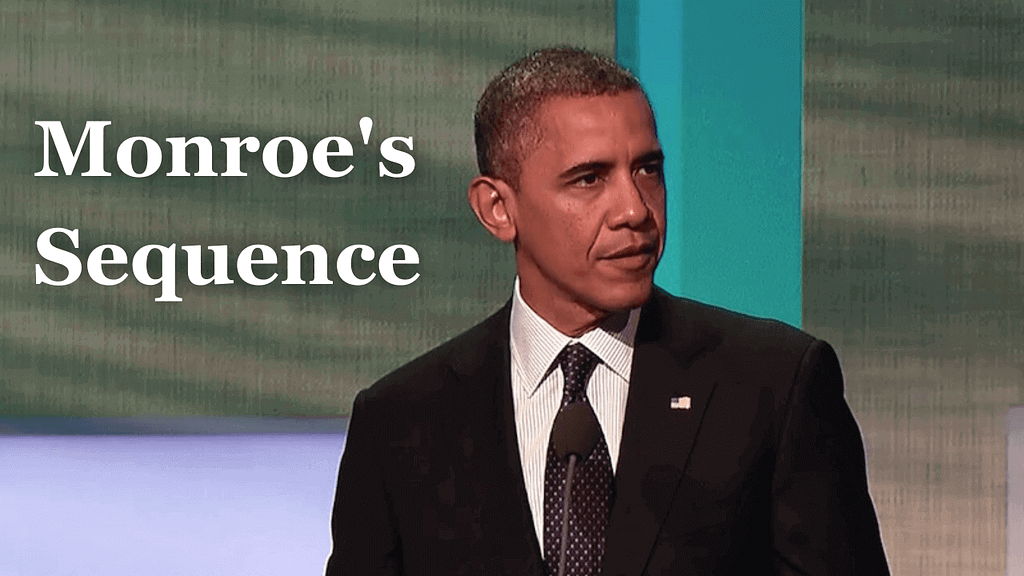
This structure was first created in the 30’s by Alan Monroe.
Since then, it has been widely popular, especially in politics, for one reason… it works.
It’s a powerful blend of psychology and rhetoric.
This 5-step framework is based on how people naturally make decisions, providing you with a clear advantage, even if you’re a beginner at public speaking.
Step 1 – Attention
People tend to go through the day on autopilot.
They’re listening but not paying attention because the speech sounds like any other kind for this type of event, so they assume that you know what you’re going to say.
You must break that pattern.
Here are some ways to do it:
- Hit them with an unexpected fact or belief:
Since we were children, we’ve been told to ‘follow your passion.’ Well, I’m here to tell you why that advice is actually sabotaging our success.
- Use an emotional story or a vivid description to trigger strong emotions
Last year, I sat across from my best friend, not knowing it would be our last conversation.
- Make a rhetorical question:
What if I told you there’s a simple way to triple your productivity in just 5 minutes a day?
Step 2 – Need
If you want them to care, make the problem feel real, urgent, and personal.
It must hit them on a visceral level and convince them that this problem affects their world.
Here are some examples:
- Start big and bold with an emotionalized statistic.
“Today, nearly 1 in 3 people worldwide doesn’t have access to clean water. Millions are dying every year from something as simple as thirst—something we could prevent tomorrow.”
- Zoom in and personalize the story to make it more relatable.
“Let me tell you about Sarah. She’s a single mother who had to leave her job
because she couldn’t afford childcare. She’s juggling bills, job searches, and two hungry kids every night. That’s her reality—and she’s not alone. Millions of families face this uphill battle every single day.”
- Paint a picture of what’s at stake.
“If we don’t act now, rising sea levels could force 200 million people from their homes by 2050. That’s like every person in the U.S. being displaced— twice.”
Step 3 – Satisfaction
Now that you’ve painted a clear, painful picture of the problem, it’s time to give them hope. You present a clear and believable solution that effectively addresses their needs.
You show them how taking small steps can lead to massive changes and how you’ve already seen success.
In Kenya, we’ve built 200 wells—wells that now bring clean, life-saving water to 50,000 people.
That’s 50,000 children who can play, parents who can work, and grandparents who can watch their families thrive—all without the fear of walking miles for dirty, dangerous water.
But this is just the beginning.
With your support, we can double—no, even triple—those numbers and transform countless more lives.
The choice is yours, and the impact is real.
Step 4 – Visualization
Help them see a great future if they act now, and a horrible future if they don’t, then wrap it up by making it personal.
Imagine children laughing and running barefoot through fields, carefree and full of life.
A fresh stream of clean water flows nearby, giving their village health and hope. Diseases like cholera are nothing but a bad memory. Parents finally sleep peacefully at night because their children are strong, safe, and healthy. This is possible because people like you decided to act.
Now imagine the alternative: Children struggling to walk because malnutrition and disease have sapped their strength. Parents watch helplessly as their little ones suffer in agony.
All because the clean water is out of reach.
Here’s the question: Which world do you want to create? Because the choice you make today could define your tomorrow.
Step 5 – Action
This is the moment where you convert all that emotional awareness into specific action. There are two elements to do it effectively:
Be specific: Saying vague phrases like “Help Today,” “Get Involved,” and “Make a donation today” might be inspiring, but they are not sure what to do next.
So spell it out clearly. What’s the exact next step? Should they sign a petition, share the message, make a donation, or volunteer?
Make the action simple to achieve and include a specific benefit.
For example, “Donate just $10 today to fund a new well for a family in need.”
It’s much better than “Support clean water initiatives.”
Finally, your CTA must come back to the story you’ve shared.
People are more likely to act when they’re emotionally invested in the problem. But only if they see how their contribution is tied to the solution.
For example, “By donating just $10 to [X organization], you’re giving children like Sarah’s the chance to thrive – to grow up healthy, educated, and full of hope.”
Now, I have provided many examples related to donations, but the same reasoning applies to virtually any speech.
Let’s analyze Barack Obama’s speech at the 2004 Democratic National Convention. It’s a masterclass in using Monroe’s structure.
It’s not directly related to him, but it had a massive impact on his career.
Many consider it as…
[CASE STUDY] The Speech That Made Obama President
Nobody came to the 2004 DNC to hear Barack Obama.
He wasn’t the nominee. He wasn’t supposed to matter. He was a junior senator from Illinois, a name buried in the program.
That morning, a newspaper asked the only honest question in the room: Who the heck is this guy?
But after that speech, everyone remembered the name.
Now, most of us will never stand on a podium, but we all have moments when we need to explain an idea to a group or even have a difficult conversation.
What made Obama’s speech compelling was that he was following Monroe’s Sequence – a simple way of organizing your ideas so people actually listen.
Grab Attention with Humility
On behalf of the great state of Illinois, crossroads of a nation, Land of Lincoln, let me express my deepest gratitude for the privilege of addressing this convention.
By mentioning Lincoln, he is borrowing the moral authority of the man who saved the Union.
If Illinois is the “crossroads of a nation,” then the man representing Illinois represents the center of the American spirit. He isn’t a Chicago politician; he is a Lincoln politician.
Tonight is a particular honor for me because let’s face it; my presence on this stage is pretty unlikely.
(Places his hand over his heart. His intonation underscores the irony of the circumstances.)
He knows what you’re thinking, “Who the hell is this guy?” and most speakers would try to prove they belong. But he drops the politician mask and speaks like a friend sharing a secret. It’s hard to be skeptical of someone who is already laughing at their own improbable situation.
My father was a foreign student, born and raised in a small village in Kenya. He grew up herding goats, went to school in a tin-roof shack. His father, my grandfather, was a cook, a domestic servant to the British.
But my grandfather had larger dreams for his son.
(Stretches his palms upwards, as if measuring the enormity of the dreams)
He takes the one thing that supposedly makes him “unelectable” – his foreign roots – and turns it into his greatest asset. He isn’t telling you a sob story about a tin shack; he is showing you the starting line of the American Dream.
If you believe in that Dream, you have to believe in him. He has trapped you with your own values.
Through hard work and perseverance, my father got a scholarship to study in a magical place, America that shone as a beacon of freedom and opportunity to so many who had come before.
(His inflection conveys patriotic pride and generates applause)
Also, notice the contrast between life in Kenya and America. He knows the audience is addicted to the idea of American Exceptionalism, so he feeds it to them.
If he praises America enough, you cannot reject him, because he is standing there as proof that America works.
While studying here, my father met my mother. She was born in a town on the other side of the world, in Kansas.
(He flashes a smile to people who cheered upon hearing “Kansas” and waves at them)
This is the final click of the lock. He takes two worlds that shouldn’t fit together (a village in Kenya and a cornfield in Kansas) and fuses them into one person: himself.
That flash of a smile is him acknowledging that the “stranger” identity has vanished.
Make the Audience Feel the Need
More work to do for the workers I met in Galesburg, Illinois, who are losing their union jobs at the Maytag plant that’s moving to Mexico, and now are having to compete with their own children for jobs that pay 7 bucks an hour.
He pivots from his own success to the audience’s pain. By naming a specific town and a specific factory, he makes a massive global problem feel like a local tragedy.
The image of parents competing with their own children for $7 an hour is a gut punch because it describes a world where the natural order has been flipped. In the American Dream, parents work so their children can have it better. Obama is showing you a glitch in the Matrix, where parents are forced to fight their own kids for crumbs.
More to do for the father that I met who was losing his job and choking back the tears, wondering how he would pay $4,500 a month for the drugs his son needs without the health benefits that he counted on.
That is the ultimate nightmare for every parent.
More to do for the young woman in East St. Louis and thousands more like her who has the grades, has the drive, has the will, but doesn’t have the money to go to college.
He is attacking the “Great Lie” of meritocracy.
We are told that if you have the grades and the will, you will succeed.
By showing someone who has both but is still failing because of money, he proves the contract is broken. He makes you furious at the sheer waste of it.
Notice how he doesn’t offer solutions yet. He is simply diagnosing the pain.
A skilled speaker knows that before you can sell a solution, you have to make the audience feel the problem deep in their bones.
He has taken three different people (a worker, a father, and a student) and used them as mirrors.
Every person in that room or watching at home sees a version of their own fears in those stories. He has replaced the feel-good energy of the opening with an urgent need for change.
Turn Pain into Hope
John Kerry believes in an America where hard work is rewarded, so instead of offering tax breaks to companies shipping jobs overseas, he offers them to companies creating jobs here at home.
His delivery is calm and composed, but he’s presenting an insane scenario. Why would you vote for people who are shipping those jobs overseas?
By not voting for him, you’re rooting for your unemployment.
John Kerry believes in an America where all Americans can afford the same health coverage our politicians in Washington have for themselves.
People in charge are not suffering as you are. They are protected. It turns their sadness into a righteous demand for equality.
John Kerry believes in energy independence, so we aren’t held hostage to the profits of oil companies or the sabotage of foreign oil fields.
He uses the word hostage to make an economic issue feel like a security threat. The way it’s framed is that this is not just a new energy plan; it’s a rescue mission.
Every solution he offers is a direct mirror of a pain he mentioned earlier.
To prevent job loss, he makes it too expensive for corporations to leave. And for the father losing health benefits, he offers the politician’s plan.
Because look, it’s not enough to be against the current way of doing things. It’s not enough to diagnose the problem. You must also offer specific solutions.
He has successfully taken the room from a state of Need (pain and frustration) to a state of Satisfaction (hope and a clear path forward).
Show Two Futures
“If there’s a child on the South Side of Chicago who can’t read, that matters to me… because it makes my life poorer, even if it’s not my child.”
This line makes it clear that they are all in this together. He doesn’t appeal to abstract morality but to their self-interest.
“Even as we speak, there are those who are preparing to divide us… the spinmasters, the negative ad peddlers, who embrace the politics of anything goes.”
Now, he draws their attention to an enemy: spinmasters and negative ad peddlers. He doesn’t name a specific politician because he doesn’t need to. He attacks the method…. They are trying to get you to hate each other.
Inspire Hope and Action
Do we participate in a politics of cynicism, or do we participate in a politics of hope? I’m talking about something more substantial… The audacity of hope.
He forces you to choose. You can be a cynic – which he has already defined as being weak, divided, and manipulated by negative ads – or you can have audacity.
He frames hope not as a soft, fuzzy emotion, but as an act of rebellion. It takes guts to hope when the spinmasters tell you to be afraid.
So you’re not simply voting; your character is being put to the test.
If we feel the same energy, passion, and hopefulness, then this country will reclaim its promise.
Stop and look at the word reclaim.
You don’t “reclaim” something that was given to you. You reclaim something that was stolen. He is telling you that the America you love has been taken hostage by the cynics, and it is your job – your specific duty – to take it back.
In other words, sitting this election out isn’t just lazy; it’s an act of betrayal.
Final Words
Obama’s speech works because it follows a perfect psychological arc:
Attention: He makes you like him by being humble.
Need: He makes you feel the pain of the broken American contract.
Satisfaction: He offers a specific person as the relief to that pain.
Visualization: He shows you that we are all connected and under attack by the dividers.
The Action: He tells them to “reclaim” the promise.
