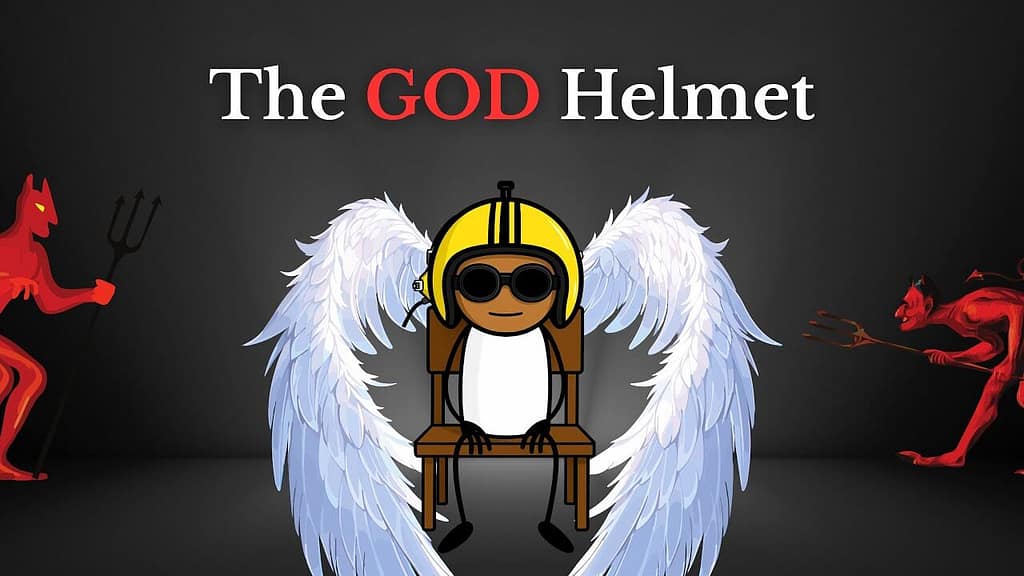
Imagine you have signed up for a relaxation study. An assistant leads you into a small, dimly lit room. She gives you a pair of dark goggles and places a modified motorcycle helmet onto your head.
This is called the God Helmet. It was built by neuroscientist Michael Persinger.
Inside the helmet, there are weak magnets that send shifting signals into your brain.
They are far weaker than a fridge magnet, but just strong enough to disturb your brain waves. And these signals are not random. The helmet is designed to mimic the very patterns that Persinger saw in people’s brains when they were having epileptic seizures or when they were lost in deep meditation.
So you are alone in a silent room with your eyes closed, and at first, nothing unusual happens. Maybe you feel a little lightheaded as if you’re floating, then suddenly, you sense that someone is there with you. The presence feels so real that you turn your head expecting to see it.
Now different people have different experiences. Some people describe the feeling as calming, as if an angel is watching them. For others, it’s terrifying, as if they are being dragged down by demons.
And some lucky bastards break down in tears because they are convinced that they are feeling the presence of God.
Now the question naturally arises, what the hell is going on inside your head?
Well, there are some brain areas that are affected and shape your experience.
First, you have the temporal lobes.
These areas handle memory, language, and emotion. But when the waves from the left and right temporal lobes fall out of rhythm, the brain interprets the mismatch as another self. And since there can only be one you, the brain concludes that there must be someone else in the room.
Next, we have the parietal lobes.
Normally, they keep track of where your body is in relation to the space around you. But when the signals above the body are disrupted, the line between you and the outside world starts to dissolve.
That’s when people describe floating above their bodies or feeling as if they have become one with the universe.
Now if the amygdala, which is the brain’s emotion center, gets involved, then it will turn the whole thing up to 11. You know, the experience becomes overwhelming.
It can feel deeply spiritual, like pure love washing over you, or it can twist into raw terror, like being haunted by something you cannot see.
And finally, you have the dopamine network. Dopamine is a chemical that makes food taste better or winning a game feel incredible.
It also fires when you’re about to discover something. So if the dopamine is released, then it will make the experience feel deeply important, as something more than just imagination.
So when all of these systems come together, the temporal lobes, the parietal lobes, the amygdala and the dopamine network, the result can be an experience so vivid that people are absolutely convinced it’s real.
And here’s where it gets more interesting.
The brain creates the raw experience, but your beliefs and culture decide how it looks.
Let’s see some examples from history.
Medieval mystics described visions of Christ or the Virgin Mary.
Shamans spoke of leaving their bodies and traveling to other realms.
Today, people report being taken by aliens or hearing voices from the dead.
So the details change with time and culture, but the overall story remains the same.
In other words, the brain gives you the presence, and belief tells you whether it’s an angel, a ghost, or an alien.
Which raises another question. Under what conditions are we most likely to have these experiences?
The first situation is when you have sleep paralysis. You wake up, but you cannot move a muscle. You feel helpless and sense a dark presence in the room, or you might see shadowy figures standing over you.
Second, we have extreme stress or fear. When your amygdala goes into overdrive, it can make you feel like someone else is there with you. It is commonly reported by soldiers in battle or people in life-or-death situations.
Then there is a deep prayer and meditation.
Brain scans show that when monks or nuns enter a state of total absorption, activity in the parietal lobe slows down. As we said, that’s the part that separates me from the world.
That’s why these people describe a feeling as if they have united with the universe, or as if they are being embraced by God.
Medical conditions can be a huge factor, such as temporal lobe epilepsy, migraines, lesions, or tumors.
There are also mental disorders like schizophrenia, bipolar disorder, and anxiety.
And of course, you have the usual suspects: psychedelics, drugs, and heavy drinking.
Finally, there’s the situation where you have been isolated and exhausted. People who push themselves to the limit, like mountain climbers or endurance athletes, have reported having imaginary companions.
The most fascinating example is Joe Simpson.
While descending from the Ciudad Grande in Peru, he met with a terrible accident. Somehow, he was still alive, but he was utterly alone, crippled, without water or food, and miles away from the camp.
Then he hears a sharp voice telling him to get up, move to that rock, do it now. After each drag, he thought of stopping and just getting it over with. But the voice was relentless; it would command him to keep moving forward.
After three days and nights, he reached base camp and was brought to health. In conclusion, people who swear they encountered paranormal activity are not lying. They really felt it.
They just didn’t realize it was a biological trick. A special effect created by their own brains, which is fucking amazing, right? It’s amazing that our brain can do this.
Now if you want to learn more about why we believe strange things, even if we have a high IQ level, then check out this article:
