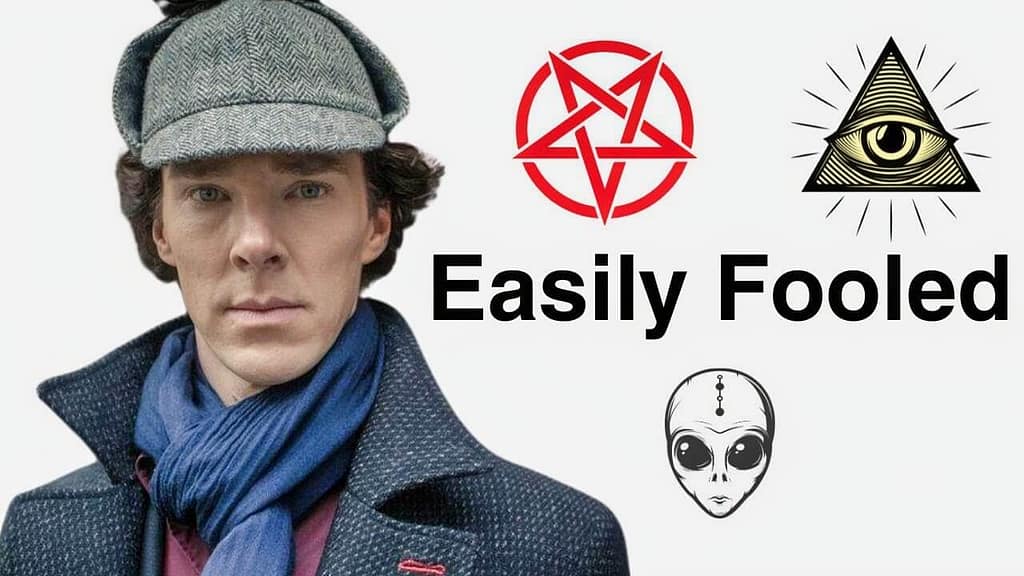
Arthur Doyle was a doctor and a writer. His best character was Sherlock Holmes, a detective who solves crimes using scientific reasoning.
But later in life, he fully and publicly embraced Spiritualism: It’s the belief that the dead can communicate with the living.
Now, how does this happen? How is it that a highly trained doctor… the man who created the most logical character in literature… believed in bs like that?
It would be like Neil deGrasse Tyson giving TED Talks on why the world is flat or that the moon landing was fake.
In this article, we’ll explore why smart people believe in conspiracy theories and irrational ideas, and how intelligence can actually make things worse.
Patternicity
Imagine you are at a stadium watching a football or a handball game, and you’re wearing your favorite shirt.
Your team was initially at a disadvantage, but then they fought well and managed to win.
As you’re walking out, still high from the game, and maybe a little from the overpriced beer, you think, “We won because I was wearing this shirt.”
The next week, you wear the same shirt again – and what do you know, they win again.
Now you’re convinced that your T-shirt brought luck to the team. And you start noticing only the games that confirm your theory, while ignoring the ones that don’t.
This is called patternicity—what researchers sometimes call illusory pattern perception. It’s our tendency to seek patterns and form associations, even when they’re not real.
Then we take it one step further. Once you spot a pattern, your brain wants to explain what’s causing it.
And instead of thinking it’s random, we often assume that someone, or something, is behind it.
This is called agenticity.
It’s why people say things like:
- The universe was sending me a sign
- Karma finally caught up with him
- Mercury is in retrograde. That’s why everything’s going wrong.
Now, why do we have these tendencies?
Well, think about the ancient person walking in the African Savannah.
He hears a subtle noise in the bushes, which is a potential sign of a predator.
If he assumes that it’s the wind, and it turns out to be a lion, then it’s game over. But if he assumes that it’s a predator and he’s wrong, then he’ll simply waste some energy running away.
Evolution favors the paranoid.
So over thousands of generations, natural selection wired our brains to be hypersensitive to patterns and quick to assume that something, or someone, is behind them.
In psychological terms, this is linked to paranoid ideation… our mind’s tendency to imagine hidden causes or threats where none exist.
In other words, it’s better to be paranoid and alive than to be skeptical and dead.
And that’s why, today, the same mental habits that once kept us alive can also lead us to believe in gods, spirits, aliens, miracles, curses, and conspiracies.
These aren’t just personal quirks; they’re part of a larger social phenomenon.
The Double-Edged Sword of Belief
Beliefs are narratives we tell ourselves about how the world works. They blend our emotions, memories, habits, and traditions into something that feels true.
Beliefs are what make life seem orderly and predictable.
But it’s not.
Chaos theory demonstrates that even slight changes can have a profound impact, resulting in massive and unexpected outcomes. No matter how smart or prepared you are, life will surprise you.
And when life gets painful, that’s when belief can turn against us.
We like to think we’re scientists… collecting evidence and testing ideas. But most of the time, we’re more like lawyers, cherry-picking arguments and rationalizations that fit what we already want to believe.
That’s the double-edged sword: we don’t care if a belief is true, as long as it makes us feel safe. And in chasing that comfort, we can end up trapped in illusions.
For example, let’s say someone fails to become an athlete or finish college; He starts drinking to feel better… and eventually becomes an alcoholic.
Or picture someone drowning in debt. To escape the stress, they start binging random videos online. A few weeks later, they’re convinced the government is secretly run by lizard people. Or my favorite, someone quits doing drugs… and becomes a religious fanatic.
These are all examples of false patterns and associations that turned into self-destructive beliefs.
So if you can’t recognize and break those patterns early, they’ll take over your thinking, and you’ll basically live in a fantasy world.
Now you might say, “I’m a very smart person. I’d never fall through a rabbit hole.”
Well, having a high IQ level won’t give you immunity. In fact, it can make things worse for you.
Because smart people are great at coming up with strong arguments to defend their irrational beliefs. And recent research in psychological science shows that these mental biases often intensify under stress or uncertainty, especially when people feel threatened.
Let’s continue with Arthur Doyle as an example. He believed in spiritualism and fairies, right?
But what I didn’t mention is that within a few years, he lost his wife, son, and brother.
Those tragedies shook him deeply, like they would anyone else.
Spiritualism gave him something that science couldn’t… hope. Spiritualism gave him something that science couldn’t… hope. In psychology, this is often linked to conspiracist ideation or generic beliefs, where people weave broad unseen forces—spirits, fate, destiny—into personal tragedy as a way to manage uncertainty.
It told him death wasn’t the end, that he could still reach the people he’d lost. And it gave him a new mission: to share this “truth” with the world.

F*cking hell, that’s a lot of work
And because Doyle was methodical and disciplined, he poured all his talent into it. He wrote books, gave lectures, and became one of the most famous promoters of spiritualism.
Doyle’s story isn’t unique.
Recent research in applied cognitive psychology and social psychology shows that when people face uncertainty, threats, or loss of control, they often turn to conspiratorial thinking. It feels safer to imagine a secret plot or government conspiracies than to accept that the world can be random and unfair.
And just like Doyle, intelligent people aren’t immune. In fact, studies suggest that high cognitive ability can strengthen arguments used to defend irrational beliefs. That’s why misinformation and disinformation spread so effectively online—they give people ready-made narratives that feel like evidence, even when they’re not.
FAQ: Why Do People Believe in Conspiracy Theories?
Do conspiracy theories provide any benefits?
Yes. Believing in conspiracies can sometimes calm anxiety by giving a simple explanation for messy, confusing events. They make people feel a sense of control, even if the story is built on disinformation or a supposed secret plot.
Are some people more likely to believe in conspiracies?
Research from people like Van Prooijen shows that traits such as distrust, strong paranoid ideation, and less analytic thinking make someone more prone. But it’s not just personality. Hard times—like losing a job, political fights, or social uncertainty—can push almost anyone toward conspiracy theorizing.
Why do conspiracy theories spread so fast online?
Social media rewards posts that spark emotions, not accuracy. That means misinformation spreads faster than corrections. If a story taps into people’s fears or biases, they’re more likely to share it. That’s why conspiracy thinking shows up across the political spectrum.
Why don’t people give up on conspiracies, even with proof against them?
Once a conspiracy becomes part of someone’s identity, evidence won’t break it. Any facts that contradict it just look like part of the cover-up. In their minds, the conspirators are always one step ahead—so the theory can never really be disproven.
What should future research focus on?
Future research should dig into why our brains see patterns that aren’t there (what’s called illusory pattern perception) and how that links to cultural stories, like the “paranoid style” in politics. That could explain not just why individuals fall for conspiracies but how they spread and shape big events in society.