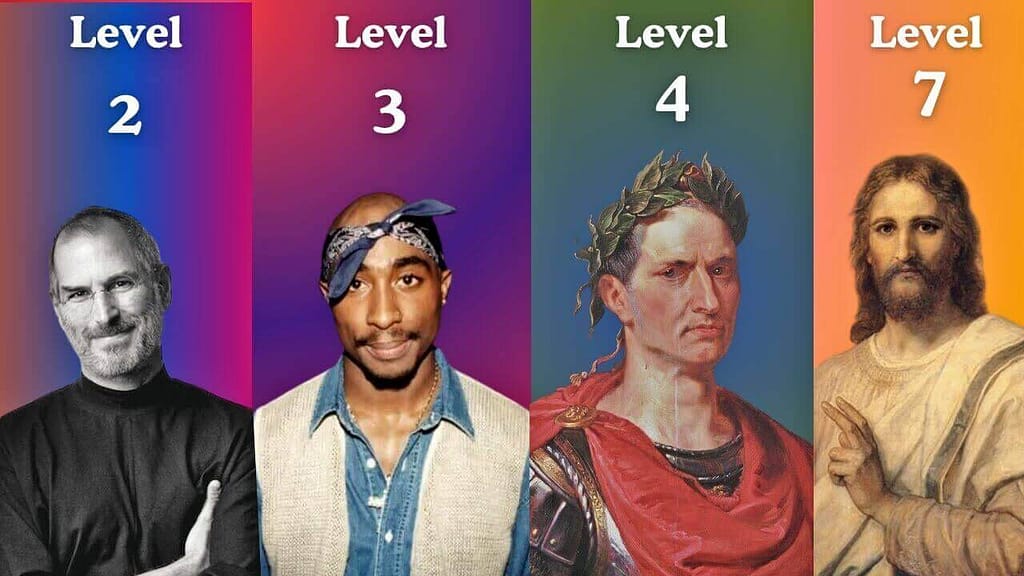
Most people believe that power is about wealth and popularity. But they’re wrong because those are just tools.
True power is about the impact you have on other people, institutions, or culture.
If you’re skilled enough with your words, then you’ll live after death for a long time.
1. The communicator
These are individuals who have the ability to present their ideas in a simple and compelling manner.
They don’t need platforms or an audience. They simply connect with people they meet in everyday situations.
In other words, they use persuasion as a tool to make life easier for themselves and the people they care about. You know, they can make you feel better when you’re down; they can teach you well; they can resolve conflicts and influence you to make better choices.
2. The Salesman
For these people, their ability to communicate and sell is not just a means to make more money; It’s part of their identity.
They thrive in figuring out human nature, and they use that knowledge to frame their product, their plan, or their candidate as the obvious choice.
It doesn’t really matter whether they believe in what they’re selling. What matters is that you do.
To them, what matters more is the result.
3. The Performers
At this level, you have the artists – the writers, singers, actors, painters… You know, highly talented individuals whose work entertains and inspires millions.
If salesmen can convince you to buy something you don’t need, performers can make you feel something you didn’t even know was inside you.
4. The Leaders
Leaders operate at scale.
Through years of trial and error, they’ve crafted a narrative that’s bigger than themselves. They’ve a vision of how the future should look for a movement, organisation, or a country, and of course, they believe that they will make that vision a reality, regardless of the obstacles.
They are very charismatic. They know how to turn doubt into loyalty, and loyalty into action.
So the masses vote for them, fight for them, even die for them.
We’re referring to modern figures such as Churchill, Obama, Trump, and Xi Jinping. But we’re also talking about kings and generals who left a significant mark on history, such as Caesar, Alexander, Ashoka, Mehmed II, Genghis Khan, Skanderbeg, and Hannibal.
5. The Propagandists
Behind popular leaders, there is also a shadow figure who helps them gain and maintain power.
They don’t really care about the spotlight. They care about being effective.
When the leader makes mistakes, the propagandist will step in. They’ll distract the masses with other stories; they’ll frame their behavior as not a big deal or even as a good thing.
In other words, if leaders are the actors on stage. The propagandists are the stage designers, the directors, and often the script writers.
6. The Architects
In this category, there are those individuals who have influenced how we think about ourselves and other people, and most importantly, they have affected how we function as a society.
We have learned about them in school, but we didn’t really pay much attention to them. Their name probably didn’t stick in your mind.
Yet, their work is present in our everyday lives, regardless of where we live.
There are too many to mention:
Some redefined how we see the world:
Plato, Marcus Aurelius, Nietzsche, Sartre, Kierkegaard, Hume, Voltaire, Foucault, Machiavelli, Simone de Beauvoir.
Some laid the foundations of modern institutions:
Aristotle, Confucius, Rousseau, Locke, Montesquieu, Kant
Others reshaped how economies function:
Adam Smith; Karl Marx, Joseph Schumpeter; W. Arthur Lewis; Alfred Marshall; John Maynard Keynes; Milton Friedman; Esther Duflo
Some changed the way we understand science and physical reality:
Francis Bacon; Galileo Galilei; Isaac Newton; Charles Darwin; Alan Turing; Albert Einstein; Niels Bohr; James Clerk Maxwell; Louis Pasteur; Marie Curie; Richard Feynman
The inventors built the tools of progress:
Johannes Gutenberg; James Watt; Samuel Morse; Alexander Graham Bell; Thomas Edison; Nikola Tesla; Wright Brothers; Henry Ford; Tim Berners-Lee
Finally, you have those who have uncovered how the human mind works.
Sigmund Freud; Carl Jung; Ivan Pavlov; B.F. Skinner; Jean Piaget; Lev Vygotsky; Abraham Maslow; Carl Rogers; Erik Erikson; Albert Bandura; Aaron Beck; Daniel Kahneman
7. The Prophets
For this level, I picked three individuals: Abraham, Jesus, and Muhammad.
They introduced a different worldview, and billions of people for over 2000 years have embraced it, spread it, and killed for it.
You see, they truly believed that they were sent by God, so naturally, they had a strong conviction in their narrative, right?
This made it easier to convince that initial group of people.
They became devoted not only to living according to the doctrine, but also to spreading it as much as possible.
Some became missionaries, traveling across continents to share the faith.
Others lived virtuous lives that quietly persuaded skeptics. And in many cases, rulers adopted the religion — and when they did, their people followed.
These were ethical, voluntary forms of conversion. But let’s be honest: that alone doesn’t explain how a religion crosses 1 billion followers.
I mean, the societies that were responsible for spreading Islam and Christianity were highly successful conquerors.
Think about it this way…
You’re a king and you set out to conquer other lands for more wealth. But making people submit is not enough. You also need to change their religion.
Because if most people in your empire have the same religion, then they’ll be much easier to control.
That’s why, when you’ve won the war, the next thing you need to do is destroy the old places of worship, and you tell the natives:
“Look, you have a simple choice: Live under our rule and adopt our faith, and you’ll have benefits.”
Or keep your religion and pay heavy taxes, lose legal protections, and basically be a second-class citizen in your own land.
Initially, most natives will choose the second option, but gradually more and more natives will give in, until you’ll have most of those people adopting your religion.
In other words, the new generations will be born into your faith and will be less likely to rebel.
So that’s how Christianity and Islam built a strong foundation.
Then, the industrial and technological revolutions improved the quality of our lives and made it possible for people to live longer and have more children, which automatically drove the number of followers up.
