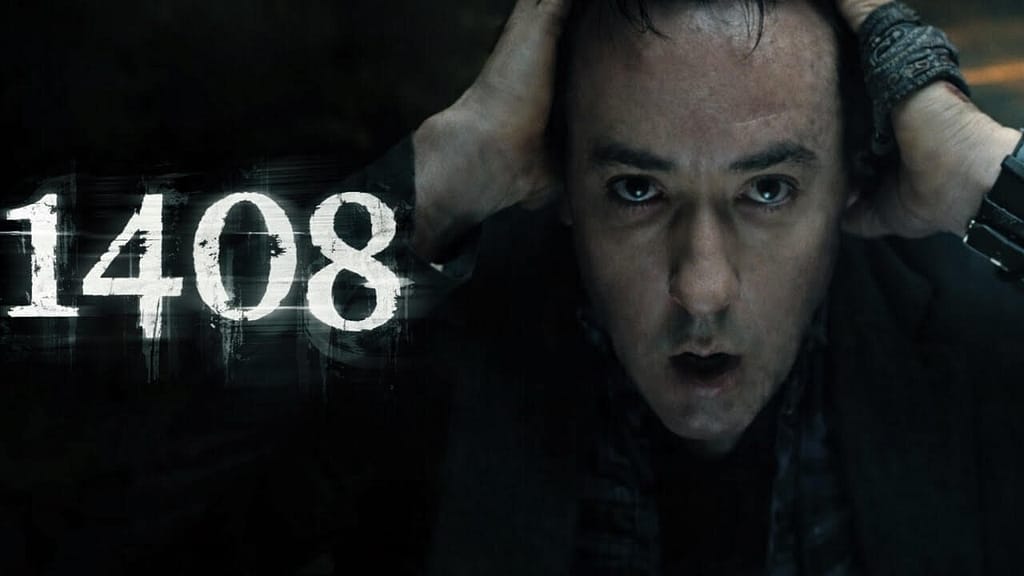
If you’re reading this, you should stop.
I’m serious. This isn’t a threat. It’s honest advice.
Because this video is not here to entertain you, and for sure it’s not about explaining an excellent movie.
It’s about revealing a dark truth about YOU, something you don’t dare to admit to yourself.
And if you’re like most people, you don’t enjoy that.
So if you’re already deciding whether this is worth it, now’s the time to leave.
Still Here?
Okay.
Mike is your hard-core skeptic who stays in so-called haunted places, but he’s not trying to debunk them. He doesn’t care enough about the story to prove anyone wrong.
He simply believes that every strange experience can be explained and endured. He believes that fear, anxiety, grief, dread, whatever shows up, will eventually burn itself out if you don’t react to it.
He treats emotions the way other people treat bad weather, something you endure quietly until it passes.
That’s the philosophy behind his life and work.
Early on, Mike is at a book signing, and a fan hands him his first book, the one he doesn’t write like anymore, and you can see land over him for just a second before he puts it away.
Because whatever part of him wrote it, that part doesn’t seem to be in the business anymore. These days, he writes cheap thrill books.
At some point, he learned how to write without feeling much, and once that worked, he didn’t see a reason to stop. Feeling alive was replaced with staying functional.
And now he travels the country as if he’s escaping something.
That’s how he ends up at the Dolphyn Hotel in New York, asking specifically for Room 1408, the room where people die.
Ollie, the manager, tries everything to stop him, but nothing works.
Interestingly, he doesn’t sound scared; he sounds exhausted.
Mike checks into the room and immediately does the usual; he describes it out loud – the furniture, windows, paint, temperature – he turns the room into something observable. You know, he uses the recorder to detach himself from the experience, and detachment is something he does all the time.
Then the radio turns on.
“Bravo, Olin,” he says, “Very unsettling.”
He’s amused. He’s still in control.
The room gradually pulls up all the cliche tricks, and Mike responds the same way we all do when we’re afraid… he tries to find a logical explanation.
But then the doubts creep in and grow louder. So Mike reminds himself that he has stayed in rooms like this before. And every time, it turned out to be nothing.
When that doesn’t work, he builds a better story:
Olin must have drugged the alcohol. Or the chocolates. There have to be cameras hidden somewhere. This is all a hallucination.
So he decides to tap into his willpower. He only needs to endure five or six hours; that’s all it takes.
And that’s when the room hints at the real “threat” it has prepared for him.
The TV turns on, and it displays something incredibly unsettling. It’s a demonic figure to tell him that he’s actually in hell.
I’m just kidding.
It’s something scarier.
The TV shows a home video of his daughter.
He gets closer to the screen and starts crying.
Then he hears a baby’s voice in the other room and tries to talk to the people staying there.
He’s thinking there’s still a chance he can get out of the room without facing it.
But he discovers it’s impossible.
Then his father shows up… He says, “As you are, I was. As I am, you will be.”
After he’s convinced that there’s no way out, the room starts confronting him with the most hurtful event of his life.
His daughter died of cancer.
And this is a harrowing kind of death for the family because it gives you time to hope that this will not happen to your loved one.
You know, Mike didn’t lose his daughter in an accident. There was no sudden shock.
There were hospital rooms. Plastic chairs. The smell of disinfectant and cold machines humming through the night. There were doctors who spoke carefully… They sound reassuring without promising anything.
Then it happens.
She’s dead.
But he didn’t spiral out of control. He just shut down and left. He couldn’t live in the same house with his wife because she reminded him of his daughter, and that was unbearable.
Earlier, we mentioned that his father tells him, “As you are, I was. As I am, you will be.”
Now, his father wasn’t cruel, but he was distant. This was his way of dealing with the pain of life.
So Mike resents him because he’s like, “You weren’t there when I needed you. You didn’t teach me how to feel.”
The irony is that he has become the same kind of man.
So, basically, his father is like: “You hate me for what I became, but you became me the moment you chose to escape the pain instead of facing it.”
Now, what’s truly frightening about the room is that it’s not unique to Mike.
Just like Mike, you’ll avoid facing your fears; you’ll take every escape that life offers to you, and every time you do, you get closer to your own version of the Dolphin Hotel.
You’ll probably encounter someone like Ollie, who will warn you to change course, not to enter the room, but you probably won’t listen because you don’t comprehend how deep you’ve gone.
Now you’ll face an event that shakes you to the core.
It doesn’t have to be a tragedy like the death of a loved one. It can be something much easier like an illness, a breakup, a failure, or any event that forces you to stop running and pay attention… to confront the fact that by living mindlessly, you’ve betrayed yourself.
The room isn’t showing him ghosts or demons; it’s actually a mirror of his unconscious mind.
It is forcing him to face all the pain, the guilt, the fears… everything he has violently suppressed for years.
As a way to cope with the pain, he uses logic and willpower, but they don’t work because what he’s facing lies in the unconscious mind.
The root of his misery is that he didn’t learn to fully experience the ups and downs of life, but he strived to stay detached. That way, nothing could hurt, right?

And when his daughter died, he couldn’t bear the loss, so he tried to escape it, which sent him inside a room where he relived his worst moments.
The room offers him a terrible way out, but he would never take it. Instead, his strategy was to keep fighting him with logic and willpower, or simply to detach himself.
But then the room reveals that his wife will be next.
That’s when he finally sees himself clearly. He admits that he’s been living a selfish life, and for the first time, he doesn’t try to escape.
He decides to confront it. Not out of bravery or growth. But because someone else is at stake. The cost of avoidance is finally visible.
So he sets the room on fire.
Now, most people never get a moment like that,
And even if they know they’re living in a loop of misery, they choose not to confront the root.
They stay in the room.
Or worse, they live their entire lives without realizing they ever walked in.
