China is a global superpower with 1.4 billion people, but the blueprint for that mind-blowing success didn’t actually come from Beijing.
It came from a tiny island that used to be owned by the British Empire.
Within a single generation, under the leadership of Lee Kuan Yew, Singapore transformed from a poor, godforsaken patch of land into an economic powerhouse.
But what most people don’t know is that Lee Kuan Yew played a key role in China’s development.
To understand how this happened, you have to look at Deng Xiaoping.
He had been a key figure of the Communist Party right from its genesis.
But then he committed one of the cardinal sins in a totalitarian state… he stopped being a fanatic and started looking at actual results.
While the elites in Beijing were still getting high on the dream of a Marxist utopia, Deng wanted to follow a different approach because this way of doing things had starved tens of millions of people to death.
He famously stood up in a meeting and declared that it doesn’t matter whether a cat is black or white, as long as it catches mice. What he meant was obvious. It doesn’t matter if a policy comes from communism or capitalism, as long as it actually makes the economy grow.
The problem is that, as we said, common sense is treason in such countries.
Mao Zedong felt threatened by his mindset, and when a dictator is paranoid, it doesn’t matter how loyal you have been to the party. He will show no mercy to you or your family.
You know, they not only oppress their opponents, real or imaginary; They also eat their own. It doesn’t matter how powerful you are, you could easily get murdered or end up in prison.
Deng was no exception.
Mao unleashed militant student mobs called the Red Guards to publicly humiliate Deng and his wife in the streets.
Two years later, things got even darker. His son was interrogated and tortured, which forced him out of a third floor window and left him permanently paralyzed.
Deng ended up in a distant province working at a factory.
He would take care of his son, and he spent a lot of time just walking, seeing the sheer, devastating scale of poverty across the country, which only cemented his belief that economic survival had to trump ideology.
Then, in 1976, Mao finally died.
This immediately triggered a ruthless struggle for power.
On one side, you had the radicals known as the Gang of Four, a group of fanatics desperate to keep the ideological purges going.
On the other side, you had Hua Guofeng [the successor appointed by Mao] and the military.
Now the military didn’t really want to continue Mao’s insanity because many high-ranking commanders were on the receiving end of it. They were stripped of their power and humiliated like Deng was.
In other words, they were done with this cultural revolution bullshit.
Now Hua Guofeng cooperated with the military to get rid of the Gang of Four, but the senior party and military leaders knew that he wasn’t the right person for the job because his philosophy was to do whatever Mao said.
So they picked Deng because he had a more pragmatic approach, he got purged like most of the elite, and more importantly, because he was a former military commander himself.
Now, Deng is holding the keys to a shattered country, but his biggest nightmare is not just the economy; it is national security.
They are scared that the Soviet Union will encircle and eventually invade them.
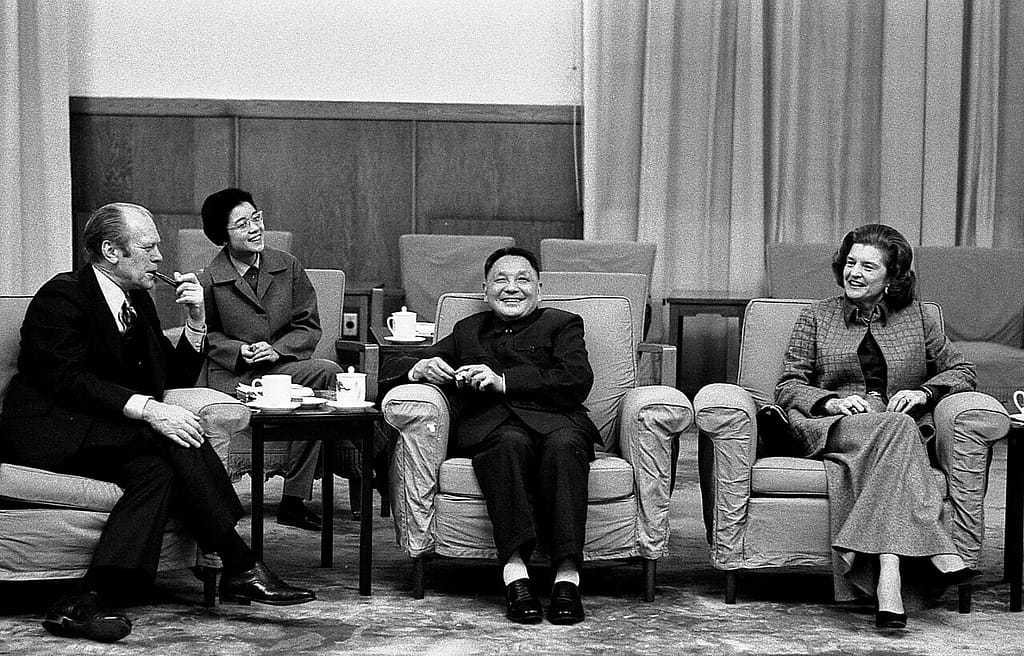
By November 1978, Deng was desperately trying to form an anti-Soviet alliance, which led him to board a plane to visit an island that state propaganda had always painted as a miserable capitalist slum.
He lands in Singapore.
The Prime Minister, Lee Kuan Yew, is showing Deng the place.
And he’s shocked.
He expected a slum, but what he sees is cleanliness, order, wealth, high-rise buildings, booming factories, a highly efficient port, and absolute political control.
The two leaders hit it off immediately.
Lee explains that the countries in Southeast Asia aren’t actually scared of the Russian Bear; they’re scared of China. Beijing had been funding violent communist rebellions in their jungles and actively spreading propaganda through local radio stations.
Now keep in mind that Lee Kuan Yew despised communism, and that’s perfectly reasonable because it is a dangerous, moronic ideology.
But did he tell him that?
Of course not.
Instead, he played to China’s deep national pride.
He looked Deng in the eye and told him, “Whatever we have done, you can do better because we are the descendants of the landless peasants of South China. You have the scholars, you have the scientists, you have the specialists”.
That single conversation hit Deng like a freight train.
If a tiny island with zero natural resources and a population of poor farmers could become this rich, imagine what a massive, ancient civilization could do?
Literally one month later, he was officially the leader of China.
In a subtle way he pushed for capitalist reforms and over the next two years he halted the radio propaganda and cut the funding for the communist insurgents in those countries.
This way he abandoned the bloody model of exporting revolutions, and traded it for the massive profits of exporting products.
So throughout his life, Deng had this rough idea of how China should function, but I think it wasn’t until he visited Singapore and spoke to LKY that he crystalized the vision.
But there was still a massive problem. How do you sell this vision to your party? At the end of the day they’re communists right?
Well, he changed the narrative.
He rebranded the new approach as “Socialism with Chinese Characteristics.”
This gave him a lot of leeway because, whatever dogmas didn’t work for China, he could simply say they were foreign and not suited to their situation.
Another core element of their narrative was the concept of “Primary Stage of Socialism”.
They said that true communism requires massive wealth, but right now, China is very poor – we are at the primary stage.
So any method that could help the economy grow is good because you can’t share wealth if you don’t have any.
The idea was that the markets, private ownership, and foreign investments were just “temporary tools” till they built the necessary foundation for a true communist country.
In other words, he was selling a dream.
And instead of pushing for large-scale reforms, he asked only for special economic zones in the deep south – Shenzhen, Zhuhai, Shantou and Xiamen.
This wasn’t just to convince the hardliners, he wasn’t really sure that it could work or lead to unforeseen existential problems.
However, he chose those cities because you have Hong Kong, Macau, and Taiwan at the border – All of them were highly developed places.
He also introduced the “Double Track” system.
Government factories still had strict production quotas to meet, but once they hit those numbers, they were allowed to sell any excess goods on the open market for pure profit.
This dramatically increased productivity levels.
But he still had to deal with the powerful, aging generals who fought alongside Mao and despised the free market.
So, in 1982, Deng created the Central Advisory Commission which is essentially a glorified retirement board.
The old guards surrendered their active power, and in exchange, the state would bankroll their mansions, bulletproof cars, and elite status for the rest of their lives.
Because of the new dual-track system and zero oversight, elite families naturally used their inside political connections to take over the new corporations and get even wealthier.
Do you think that the new generation gives a fuck about the ideology once they see their pile of money getting bigger?
Exactly.
Now, eventually, the system tested in those southern economic zones became the blueprint for the entire country. You have one party always in power but from an economic perspective they’re capitalists.
In addition, Deng sent thousands of Chinese bureaucrats to Singapore to study what made their system so efficient.
But of course, China was never radically anti-corruption, except for what Xi Jinping did in 2012 because things had really gotten out of hand. Even then, it didn’t really work because now the bureaucrats are not incentivized enough to be productive.
Corruption was necessary to change the system and since then it has been at a cellular level.
Plus, it’s a massive country so you cannot give extremely high salaries and enforce draconian measures like in Singapore. It would never work.
This brings us to the core strength and the ultimate vulnerability of CCP.
As long as GDP increases, high-ranking officials get wealthier; the state can offer more services so that the ordinary citizens live better, there’s no need to change the system. I mean it’s too much of a hassle.
But what happens if the goose doesn’t produce golden eggs anymore? How are the ordinary people and the elites going to accept increasing limitations on their personal freedoms?
To put it in other words, the social contract [in my view, of course] is that the government can limit your freedom, but you get richer than your parents.
However, if there’s no growth due to a massive real estate bubble or a demographic collapse because young people are not having children, then the contract will be broken.
This means that if they don’t fix the economic problems, it doesn’t matter that they have the surveillance system from the Dark Knight, CCP will be in serious trouble.
You know, if you are an American and you’re struggling then you can easily vote out Biden, Trump or whoever is in charge.
The pressure is released.
The country keeps moving.
But you cannot do that in China.
CCP is directly responsible for everything.
When you demand absolute credit for the sunshine, you’ll also get absolute credit for the storm.
Nevertheless, we’ll see in the future how the situation will play out.
But we have these two individuals who had a vision for their countries; they understood incentives and group behavior at a deep level and basically laid the path for their countries to become world superpowers.
Now, Deng was a dictator, and LKY ruled Singapore with an iron fist. But here is what separated them from the rest of the authoritarian leaders and dictators of the 20th century.
Those dictators fought human nature or turned it against the people. At the beginning, they ask people to be selfless and pure in service of the country/party. Then they tap into their worst instincts to oppress their fellow citizens.
You know, in a totalitarian country, it is normal for your neighbor, your relative, or even your own kid or father to spy on you.
And keep in mind that they know fully well that once you’re in court, your life is destroyed. Yet they are so brainwashed that they are willing to throw you in fire for the good of the party.
But Deng and LKY followed a different approach. They understood that humans are inherently greedy, tribal, and self-interested, and they used those traits as the engine of the state.
That deep understanding of human behavior is exactly how they built these massive economies and lifted hundreds of millions of people out of extreme poverty.
I would add that when we look at China, Singapore or even the US, we can point to a few individuals who were way ahead of their time and set up the operating system that effectively ensured the prosperity of the country long after they were dead.
